What Is the Bullet Ant Called When Its a Baby Bullet Ant Baby Name
Bullet Ant Profile
The Bullet Ant (Paraponera clavata) is an emmet species found in lowland tropical rainforests in Fundamental and South America.
They are famous for having the near painful sting in the world which is said to be comparable to the pain of being shot, giving them their proper noun.
They are sometimes called the 'big black pismire', 'conga pismire', 'the lesser giant hunting ant' and the '24-hr emmet' referring to the full day of pain that follows after beingness stung by 1.
They are members of the order Hymenoptera, to which nearly ants, wasps and bees belong.
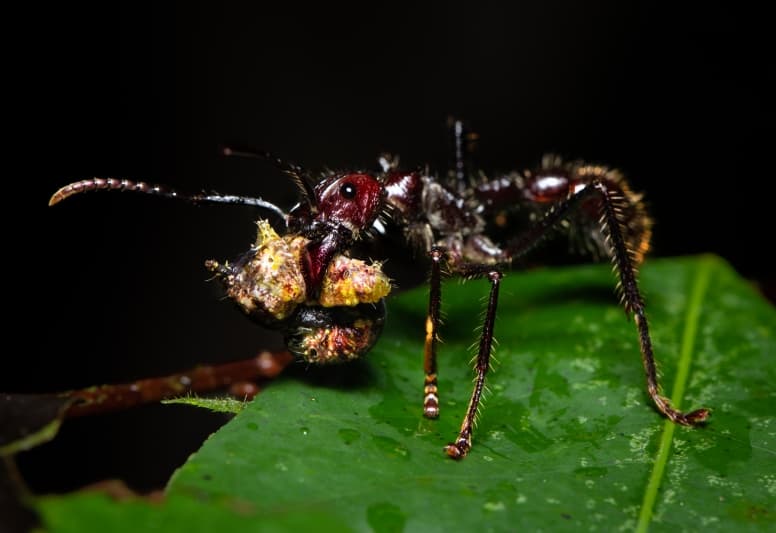
Bullet Ant Facts Overview
| Habitat: | Tropical forests |
| Location: | Central & S America |
| Lifespan: | Up to 90 days (for worker ants). |
| Size: | 18-30mm (0.7-1.ii in) long |
| Weight: | Equally much every bit 60mg |
| Colour: | Reddish-black |
| Nutrition: | Small arthropods and nectar |
| Predators: | Other Bullet Ant colonies, parasitic flies |
| No. of Species: | i |
| Conservation Status: | Unknown |
Bullet Ants are famous for their sting, and are ane of the worlds largest ants, with distinctive mandibles (pincers) and a large stinger extending from their abdomen.
Like many members of the order Hymenoptera, they live in circuitous colonies with hundreds of members. They have lots of forager ants who collect food and bring it dorsum to the nest which is where the queen pismire and her larvae live.
Their nests are often at the base of trees with buttress roots. Worker ants will climb up and downwards trees searching both for small arthropods, and for nests they can raid for nectar.
They attack small arthropods with their sting, the venom of which paralyses or kills them. Whatever goodies they observe they carry back to the nest in their large mandibles.
As with many invertebrates in the torrid zone, there is non enough data to know the conservation status of Bullet Ants. Withal, their habitat is under threat, meaning they are probable also threatened. i
Interesting Bullet Emmet Facts
1. Bullet Ants Accept The Nearly Painful Sting In The Globe
The Bullet Emmet sting is said to be the most painful of any insect. This was discovered by a man called Justin O. Schmidt, who claims to have been stung by virtually every stinging member of the Hymenoptera order. He had this to say near existence stung by a Bullet Ant:
"pure, intense, brilliant pain…similar walking over flaming charcoal with a three-inch nail embedded in your heel." ii
The sting can last for 24 hours, and symptoms include fever, nausea, trembling and cardiac arrhythmia.
Schmidt created the Schmidt scale of insect pain, which has iv categories. The Bullet Ant was the only insect in category 4 (the highest level), until it was joined past the Tarantula Hawk, who's sting lasts considerably less time at 2 hours.
While their sting is painful, they aren't by and large ambitious. When provoked, they will typically clench downwards with their mandibles first (also painful), before stinging. However, when they sting, they release a chemical that makes all the ants around them go into a stinging frenzy.
2. They Are Ane Of The Largest Ant Species
Bullet ants can abound upward to an incredible i.two inches long, which makes them i of the largest true ant species in the world. Unlike other ant species, the queen of a bullet ant colony is unremarkably around the same size as the workers.
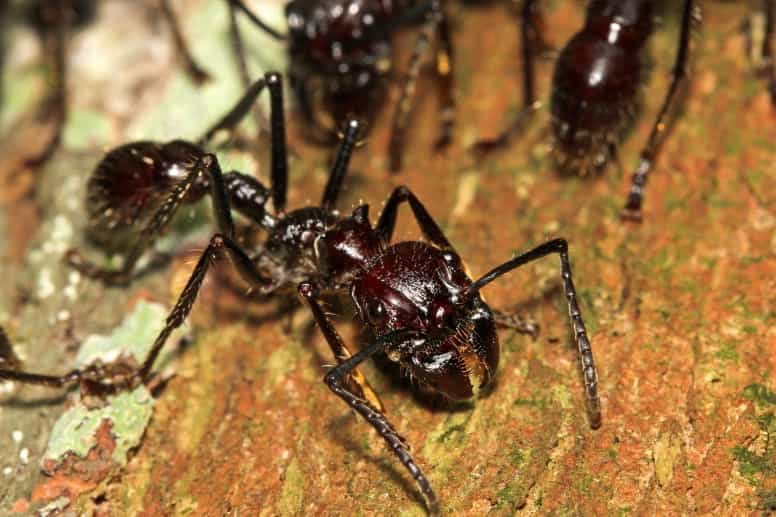
Giant Bull Ants, which are native to Australia, range between 0.3 and about 1.5 inches long. While Dinoponera, too known every bit Giant Amazonian Ants, are the worlds largest ants which abound up to one.half-dozen inches in total body length.
iii. Bullet Ants Take A Powerful Venom
The toxin in their venom is called poneratoxin. It works past altering the normal function of synapses (communication points in the nervous arrangement) in both vertebrates and invertebrates. Information technology makes the synapses go into overdrive, sending lots of signals to the encephalon, which is what causes pain.
The venom is so stiff that it is being researched for its potential as a natural pesticide. 3
4. They Accept Their Very Own Parasite
The jungle is full of parasites, about of which accept evolved highly specific relationships with their hosts. The Phorid Fly (Apocephalus paraponerae) is one such parasite. Bullet ants, while not more often than not aggressive, volition often fight brutally with other Bullet Ant colonies over food. 4
Phorid flies are attracted past the pheromones produced by wounds on the ants. Once they find the injured ants, they lay their eggs in the wounds. Typically, many females eolith eggs in just one host, so later on 2-three days you lot may get as many equally 30 larvae on merely 1 Bullet Pismire! 5
5. They Are Scavengers
Until very recently, it was thought that bullet ants ate mainly small-scale arthropods and nectar. However, a recent study published but this year found that they also scavage carrion (dead animals). 6
This find changes how we empathise their role in rainforest nutrient webs, suggesting they might be important scavengers. It also highlights how little we know near tropical rainforests, and how new fun facts are beingness plant every day.
six. They Are Used In A Grueling Initiation Past The Sateré-Mawé Tribe
The Mawé are an indigenous Amazonian tribe, constitute in Brazil, who still exist primarily in isolation from the exterior earth. However, they've get well known for 1 of their terrifying initiation ceremonies.
To become a Mawé warrior, young men must endure multiple simultaneous Bullet Emmet stings, all while keeping a directly face. Using a special herbal brew, ants are sedated and sown into a glove (stingers facing inwards) which boys (some equally young every bit 12) must wearable for x minutes.
They must have the courage to endure this ceremony a total of 20 times to be considered a Mawé warrior. 7
Bullet Pismire Fact-File Summary
Scientific Classification
| Kingdom: | Animalia |
| Phylum: | Arthropoda |
| Subphylum: | Hexapoda |
| Form: | Insecta |
| Subclass: | Pterygota |
| Order: | Hymenoptera |
| Species Name: | Paraponera Clavata |
Fact Sources & References
- McGee KM, Eaton W. The Furnishings of the Conversion of a Primary to a Secondary Tropical Lowland Forest on Bullet pismire (Paraponera clavata) Foraging Behavior in Costa Rica: A Possible Indicator of Ecosystem Condition. J Insect Behav. 2014;27(two):206-216. doi:ten.1007/s10905-013-9413-5.
- Schmidt J. The Sting of the Wild . 1st ed. Johns Hopkins Academy Printing ; 2016.
- Johnson SR, Rikli HG, Schmidt JO, Evans MS. A reexamination of poneratoxin from the venom of the bullet emmet Paraponera clavata. Peptides. 2017;98:51-62. doi:10.1016/j.peptides.2016.05.012
- Breed Doc, Stiller TM, Fewell JH, Harrison JM. Intercolonial Interactions and Nestmate Discrimination in the Giant Tropical Ant, Paraponera clavata. Biotropica. 1991;23(3):301. doi:10.2307/2388208
- Brownish B V., Feener DH. Life history parameters and clarification of the larva of apocephalus paraponerae (Diptera: Phoridae), a parasitoid of the behemothic tropical ant paraponera clavata (hymenoptera: Formicidae). J Nat Hist. 1991;25(i):221-231. doi:10.1080/00222939100770131
- Romero A, Montaño J, Soto Cedeño A, Oliveros Layola G. First report of bullet ants (Paraponera clavata) sequestering vertebrate carrion. Food Webs. 2020;24:e00151. doi:10.1016/j.fooweb.2020.e00151
- Nuwer R. When Becoming a Man Ways Sticking Your Manus Into a Glove of Ants, Smithsonian Magazine. Published 2014. Accessed December 4, 2020.
Source: https://factanimal.com/bullet-ant/
0 Response to "What Is the Bullet Ant Called When Its a Baby Bullet Ant Baby Name"
Enregistrer un commentaire